

Airports Look Complicated. The Process Doesn’t Have to Be.
Airports are busy, rule-heavy places, so it’s easy to assume that advertising there is out of reach for anyone but the biggest brands. In truth, the process follows the same logic as any good campaign: know your goal, know your audience, pick your spot and keep your message simple.
If you’re curious about advertising at an airport, here’s a step-by-step walkthrough, from first idea to final results, with no jargon.
Step 1: Set a Clear Goal
Start with one question: what do you want this ad to do?
- Build awareness of a new brand or product
- Welcome visitors and bring them to your hotel, restaurant or attraction
- Promote an event or festive campaign
- Drive enquiries with a QR code or WhatsApp keyword
- Support a bigger campaign that runs across other media
Pick one main goal. An ad that tries to do everything usually does nothing well.
Step 2: Know Which Traveller You Want
Not everyone in an airport is the same. A few groups you might be talking to:
- Local travellers heading out, who are thinking about their trip
- Returning Malaysians, who are tired and happy to be home
- Tourists, who need ideas, directions and recommendations
- Business travellers, who value time, comfort and convenience
- Families, especially during school holidays and festive seasons
Each group notices different things. Choosing one or two will make your message much sharper.
Step 3: Think About Where They’ll See You
An airport is made up of different zones, and travellers behave differently in each:
- Arrival and entrance areas: the first impression. People are moving, so keep it bold.
- Check-in and queues: people stand still and have time to look around.
- Departure halls and gates: people wait, relax and browse.
- Baggage claim: people have just landed and need a ride or a room.
- Exit routes: the last message before they step into the city.
Match your goal to the zone. If you run a hotel, baggage claim and arrivals make more sense than the departure gate.
Step 4: Choose a Format
Once you know the zone, the format is easier to pick. In general:
- Large displays and wraps suit bold branding.
- Digital screens suit timely promotions and changing messages.
- Lightboxes and backlit panels suit strong visuals and a polished look.
- Pillar wraps suit repeated exposure along a walkway.
- Baggage area displays suit messages for people who have just landed.
Which formats are available depends on the airport and the operator, so ask your media partner what’s on offer at the terminals you want.
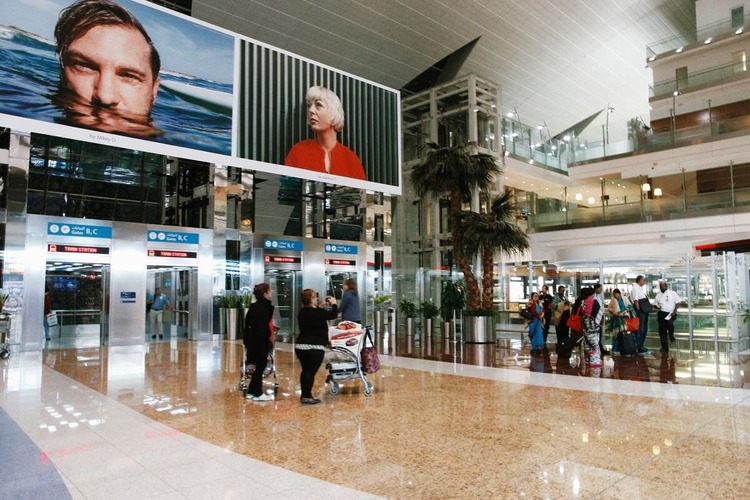
Step 5: Write a Message That Fits the Space
An airport is full of signs, screens and announcements, so your ad has to be easy to take in.
- One idea. Don’t try to say everything.
- Few words. A short headline and your brand name are enough.
- Clear contrast and big text. It has to be readable from a distance and in varied lighting.
- A message that fits the moment. “Welcome back” belongs in arrivals, not at departures.
- Language for your audience. Local travellers, tourists and business visitors may respond to different tones, and simple English often works well for visitors.
- One action. Scan, WhatsApp, visit or search.
Step 6: Check the Rules and Lead Time
This is the step many first-timers skip, and it’s the one that can delay a campaign. Airports usually have guidelines for content, design and installation, and ads often need approval before they go up.
- Ask about content rules early. Some categories or claims may need extra care.
- Ask about design requirements. Sizes, file formats and safe areas for text can differ between formats.
- Ask about approval time. Allow room for changes.
- Ask about installation and booking periods. Some spots have minimum run times or set start dates.
You don’t need to know the answers yourself. A media partner can walk you through the specifics for each airport and format.
Step 7: Plan the Timing
When your ad runs matters as much as where.
- Festive seasons and school holidays bring more travellers, but spots can fill up early.
- Launches and events need a build-up, so start before the date that matters.
Work backwards from the day you want results, and leave extra time for design, approval and installation.
Step 8: Book and Prepare
Once the plan is clear, you’re ready to confirm. Before the ad goes up:
- Finalise the design and check spelling, numbers and contact details twice
- Test any QR code on a few phones
- Make sure your website, social pages or WhatsApp are ready for new visitors
- Brief your team so they know what to expect and how to record enquiries
Step 9: Track What Happens
Airport ads don’t come with a click counter, but you can still see the effect.
- Use a dedicated QR code, promo code or WhatsApp keyword that only appears on this ad.
- Ask new customers how they heard about you.
- Watch for more brand searches, enquiries and bookings while the ad runs.
- Compare against a normal week before the campaign.
Write down what you see, and use it to improve the next round.
A Made-Up Example
Imagine a small tour company, “Jalan Jalan Trails”, wanting more bookings from visitors. The owner decides her goal is enquiries, and her audience is first-time tourists. She chooses a display in the baggage claim area, with a friendly line: “First time in Malaysia? Let us show you around. WhatsApp ‘TRAILS’ for a free itinerary.” She checks the content guidelines and design sizes with her media partner early and plans the start date ahead of the school holidays.
Over the following weeks, WhatsApp messages with the keyword start coming in, and a few visitors mention seeing the ad at the airport.
*The company and the story are fictional.
Boarding Time
Advertising at an airport is easier than it looks when you take it step by step. Know your goal and your traveller, choose the right zone and format, keep the message simple, and leave room for approvals and tracking.
If you’d like help planning your first airport campaign, the team at Avyan is happy to talk it through. Drop us a message anytime. No hard sell, just a friendly chat about advertising at an airport and whether it suits your brand.