
When the Whole Train Becomes Your Billboard
You’re at the platform, scrolling through your phone, and a train glides in covered from end to end in one big, bold design. For a second, everyone looks up. That’s the pull of a train wrap.
It’s one of the most eye-catching ways to advertise in the city, and also one that many business owners find a little mysterious. What exactly is it, how does it work, and is it right for you? Let’s break it down.
So, What Is a Train Wrap?
A train wrap is exactly what it sounds like. A large printed design, usually made of vinyl, is applied over the outside of a train, and sometimes the inside as well. Instead of a small panel on a wall, your brand covers the carriage itself.
Because the train moves through the city all day, your message travels with it, past stations, offices, roads and neighbourhoods. People see it from the platform, from nearby buildings, from the road, and from other trains.
The Main Kinds of Train Wraps
Not every wrap covers the entire train. Here are the common options:
1. Full wrap.
The whole train, or most of it, is covered in one design. It has the biggest impact, and it’s usually used for big launches and major campaigns.
2. Partial wrap.
Only some carriages or sections are covered, or the design covers part of each carriage. Still very visible, with a more flexible scope.
3. Carriage-by-carriage design.
Each carriage carries a different part of the design, so the message unfolds as the train passes. A good way to tell a story or show a series of products.
4. Window and door wraps.
Graphics around the windows and doors. A lighter option that still stands out at the platform.
5. Interior wraps.
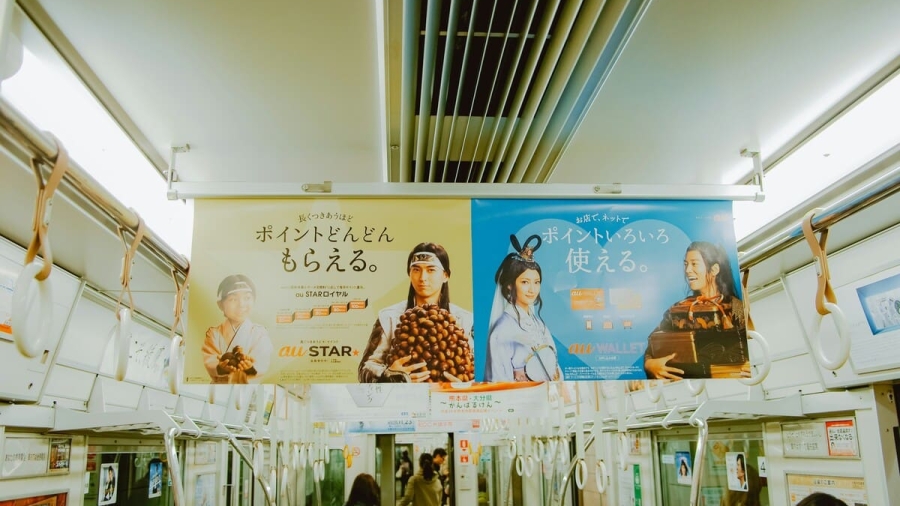
Branding inside the carriage, such as on poles, seats, doors and ceilings. Riders have time to look around, so this suits detail and storytelling. Some interior formats go by names like horseshoe or turnstile wraps, which wrap around seating or entry points.
Which formats are available depends on the operator and the line, so it’s worth checking early.
Why Brands Choose a Train Wrap
- It’s hard to miss. A whole train in one design stands out, even in a busy city.
- It travels. One wrap is seen in many places during a single day.
- It reaches more than riders. People at stations, on the road and in nearby buildings see it too.
- It feels like an event. A train wrap makes a launch or campaign feel big and public.
- It’s great for pictures. People like taking photos of unusual designs, which can lead to free sharing on social media.
- It builds familiarity. The more people spot your train, the more your name feels familiar.
What a Train Wrap Can’t Do
Let’s be honest about the limits.
- No instant click. People can’t tap a train. They have to remember you and look you up later.
- It’s hard to measure exactly. You can track with QR codes, promo codes and enquiries, but not as precisely as digital.
- It’s best with a short message. A moving train is seen quickly, so long text gets lost.
- It needs lead time. Design, printing and installation take planning, so it isn’t something to rush the week before a launch.
- It’s not a targeted tool. You can choose a line, but you can’t pick individual viewers.
Who Is a Train Wrap Right For?
A train wrap tends to suit:
- New brand or product launches that need to be known quickly
- Property developers announcing a project or showroom opening
- Events and festivals that want a big public buzz
- Colleges and universities during intake periods
- Established brands that want to stay at the top of people’s minds
- Seasonal campaigns around Raya, CNY, Deepavali and year-end
If your message is simple and your goal is to be seen and remembered widely, a wrap fits well.
Who Might Want to Think Twice
It may not be the best first step if you:
- Have a very small budget and need a tightly targeted audience
- Run a single-location business with customers far from the train line
- Need instant, trackable sales this week
- Have a complex message that can’t be boiled down to a few words
- Don’t have enough time to plan the design and installation
In those cases, a few station panels or in-train ads may be a gentler way to start.
A Made-Up Example
Imagine a new bubble tea brand, “Teh Manis Co.”, opening several outlets along one rail line. They choose a partial train wrap in their signature colours, with a big image of their drink and one line: “Your next break starts here.” A QR code on the inside panels leads to a free topping offer.
Commuters notice the wrap first, then spot the outlets near their stations. Some scan the QR code. Others just visit and say, “I saw your train.” The wrap works as a headline, and the outlets and the offer finish the sentence.
(The brand, the line and the story are fictional.)
Design Tips That Matter for Wraps
A wrap is a big canvas, but that doesn’t mean more is better.
- One big idea. A single strong image or message works better than a collage.
- Bold colours and strong contrast. The design has to read from a distance and in motion.
- Few words. A short headline and your brand name are enough.
- Think about the shape. A train is long and low, so the design should work across several carriages and from the side.
- Include one action. A short URL, a QR code or a WhatsApp keyword.
Questions to Ask Before You Commit
- What is my main goal: awareness, a launch, or an event?
- Which line and route match my customers?
- How early should I book, and how long does installation take?
- Is it a full wrap, a partial wrap or an interior option?
- How will I tell it’s working?
- Can I support it with other media, like station ads or social media?
Making Your Move
A train wrap isn’t for every brand, but for the right one, it turns a daily commute into a moving billboard. Think about your goal, keep the message simple, and plan early.
If you’re curious about whether it suits your business, the team at Avyan is happy to chat. Drop us a message anytime. No hard sell, just a friendly conversation about whether a train wrap makes sense for you.