
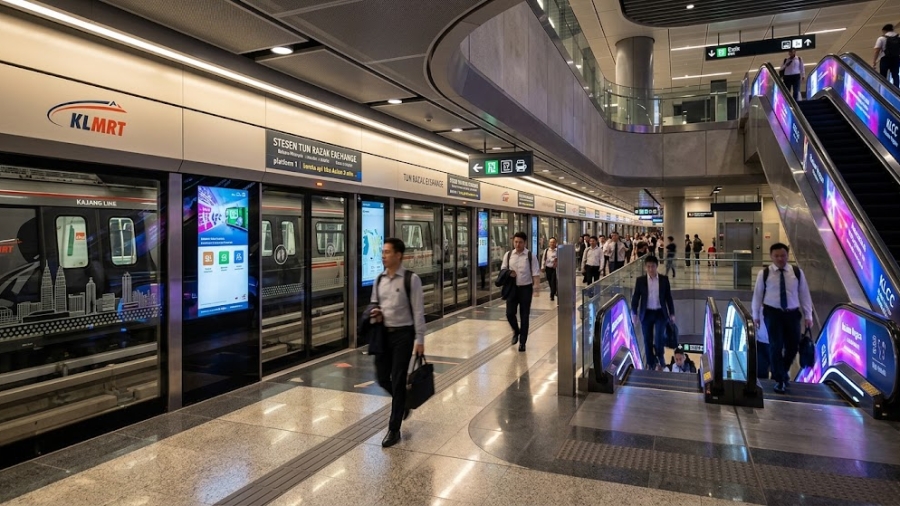
Reaching the fast-moving professional workforce of the Klang Valley requires marketing touchpoints woven directly into their daily commutes. Implementing a comprehensive MRT station advertising framework allows your brand to reach daily commuters across key lines like the Kajang and Putrajaya routes. By placing advertisements within these busy transit environments, businesses can create regular visibility among people travelling around the city.
Many passengers use the MRT as part of their normal routine. They may take the same route when travelling to work, university, shopping malls or other places. Because of this, the same person may come across an advertisement more than once during the week.
This is one of the main differences between MRT advertising and some other forms of outdoor advertising. Instead of only depending on someone passing a particular location once, businesses can place their advertisements somewhere that regular commuters may visit repeatedly.
Target Commuter Demographics via Precision Station Selection
The station chosen for a campaign can change the type of audience that sees it. A busy interchange such as TRX, for example, serves people travelling through a major commercial area, while other stations may be closer to residential neighbourhoods or shopping areas.
This is why passenger location is worth considering alongside traffic numbers. A campaign intended for office workers may use a different station from one intended for shoppers or nearby residents.
Choosing a Station Based on the Audience
Choosing the right station depends on the campaign. A station near offices may suit a business trying to reach working commuters, while stations near residential or shopping areas may suit a different audience.
Placement inside the station matters as well. An advertisement near an entrance may be seen while people are moving quickly, whereas passengers waiting on a platform have more time to look around.
Maximizing Impact with Experiential Tunnel and Platform Assets
Subterranean transit environments offer distinct architectural advantages that block out external distractions, focusing the commuter’s eye entirely on your media. Utilize digital escalator panels that display sequential, animated storytelling as passengers transition between ticketing concourses and train platforms. For maximum visual impact, long-format platform screen door stickers engage commuters during the predictable 3 to 5-minute wait times for train arrivals.
If your brand aims to bridge local urban transit visibility with global corporate prestige, integrating these commuter assets with an airport terminal advertising campaign builds a powerful marketing funnel across local and international travel networks.
Advertising While Passengers Wait
Platform areas can be useful because passengers normally spend some time waiting for their train to arrive. During this time, they may look around the station and notice advertisements placed nearby.
However, the advertisement should still be easy to understand. Some passengers may only look at it briefly, so using a clear image and a simple message can make the advertisement easier to notice.
If your brand aims to connect local urban transit visibility with international travel, these commuter assets can also be combined with an airport terminal advertising campaign. This allows a similar campaign to appear at different points of a traveller’s journey.
Technical Production Standards for Indoor Transit Formats
Executing a high-traffic transit campaign also requires businesses to consider the materials and display format used for the advertisement.
Physical advertisements placed around station walls, pillars or floors should be suitable for the location where they are installed. Digital advertisements should also be designed so that the images and text remain clear when viewed from the expected distance.
Keep the Design Clear
The design should also consider how passengers move around the station. Someone waiting at a platform has more time to look at an advertisement than someone walking towards an exit.
Because of this, the main message and visuals should be kept clear and easy to recognise.
Businesses should also work with their media partner to make sure the advertisement follows the requirements of the selected station and advertising format.
Conclusion
Transit-based outdoor media can provide businesses with repeated visibility among people travelling around the city. Selecting suitable stations, using appropriate advertising formats and maintaining a clear design can help businesses communicate their message to commuters.
However, businesses should not choose an advertising location only because it is busy. The station should also suit the audience the campaign is trying to reach. Passenger movement, location and the type of advertising space are worth considering before choosing a placement.
Ready to dominate urban transit routes? Reach out to our media specialists to build your custom transit advertising strategy.